Understanding Art, Experience, Meaning, and Value
AESTHETICS AS A WAY OF SEEING
Aesthetics is not only the study of beauty. It is a way of exploring how we experience, perceive, interpret, and value art and the world around us.
This module introduces the fundamental questions of aesthetics and provides a foundation for understanding art as experience, meaning, judgment, and value.
LEARNING OBJECTIVES
By the end of this module, learners should be able to:
- Explain the meaning and development of the concept of aesthetics.
- Identify the scope and objects of aesthetic inquiry.
- Explain the functions and significance of aesthetics in art and everyday life.
- Distinguish aesthetic experience, taste, judgment, and aesthetic value.
- Apply basic aesthetic concepts to the reading and interpretation of artworks.
- KEY CONCEPTS
- Aesthetics explores several interconnected concepts:
- Aesthetic experience — how we perceive, feel, imagine, and reflect when encountering art or the world around us.
- Aesthetic judgment — how we evaluate and interpret aesthetic experience.
- Aesthetic value — what makes an experience, object, or artwork meaningful or valuable aesthetically.
- Taste — personal preferences shaped by experience, culture, knowledge, and context.
- Beauty — one important dimension of aesthetics, but not the whole of aesthetic experience.
KEY QUESTION
Is aesthetics only about beauty?
This question will accompany the entire learning journey.
WHAT IS AESTHETICS?
Aesthetics is a branch of philosophy concerned with questions about art, beauty, taste, experience, and value. However, aesthetics is not limited to determining whether something is beautiful or ugly.
It asks deeper questions: How do we experience an artwork? Why does something appear meaningful or moving to us? How are aesthetic judgments formed? And how are those judgments influenced by culture, history, and context?
In this sense, aesthetics is both a philosophical inquiry and a way of understanding human experience.
THE SCOPE OF AESTHETICS
Aesthetics addresses a broad range of questions concerning human experience and the ways in which we encounter art and the world.
Its scope includes:
- Beauty and the beautiful — What makes something appear beautiful, harmonious, or compelling?
- Taste and judgment — How do people develop preferences and make aesthetic judgments?
- Art and artistic value — What makes an artwork significant, valuable, or worthy of attention?
- Aesthetic experience — What happens when we become deeply engaged with an artwork, object, place, sound, or environment?
- Meaning and interpretation — How do cultural, historical, and personal contexts shape the meaning we find in art?
- Art, culture, and society — How are aesthetic values connected with identity, social structures, traditions, and cultural change?
Aesthetics therefore moves beyond the question of whether something is beautiful. It investigates how aesthetic experience is formed, understood, communicated, and valued.
AESTHETICS, ART, AND BEAUTY

Aesthetics is closely related to art and beauty, but these concepts are not identical.
Art refers to human practices and works through which ideas, experiences, emotions, perceptions, and meanings are expressed or explored.
Beauty refers to one possible quality of aesthetic experience. Something may be experienced as beautiful, but aesthetic experience can also involve the sublime, the strange, the disturbing, the tragic, the playful, or the unfamiliar.
Aesthetics examines how these experiences occur and how they become meaningful.
The relationship can therefore be understood as:
Art → creates or enables experiences
Aesthetic experience → involves perception, attention, emotion, imagination, and reflection
Beauty → one possible dimension of aesthetic experience
Aesthetic judgment → evaluates or interprets the experience
Meaning and value → emerge through the relationship between the artwork, the viewer, and its cultural and historical context.
This relationship reminds us that aesthetics is not simply a search for beauty. It is an inquiry into how human beings experience, interpret, and give value to the world.
AESTHETIC EXPERIENCE
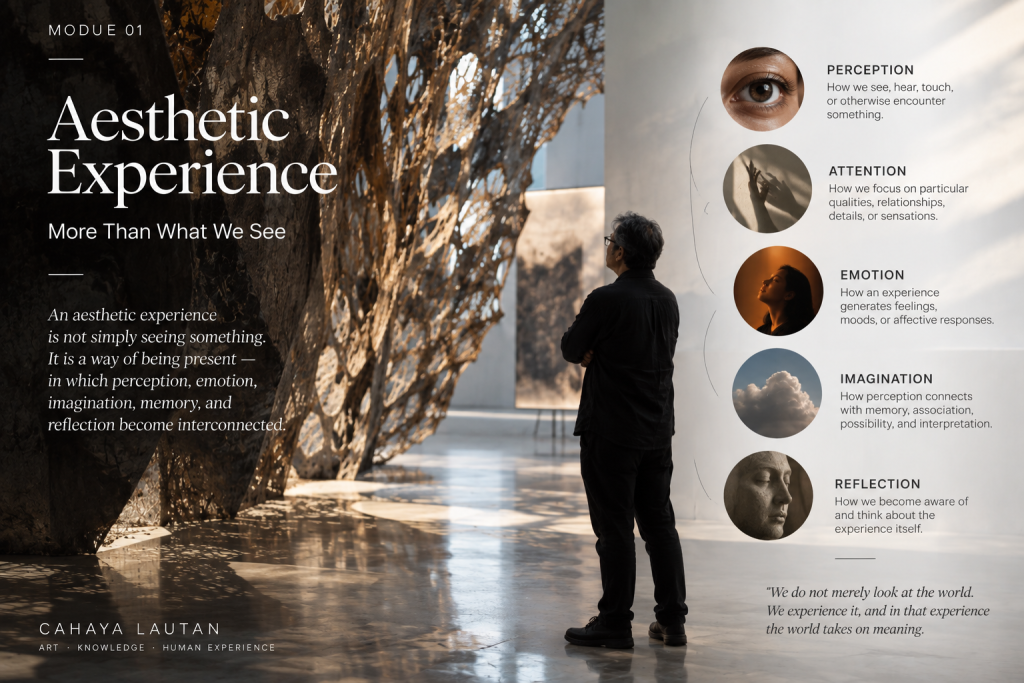
Aesthetic experience is not simply seeing or noticing something. It involves a particular quality of attention and engagement in which perception, emotion, imagination, memory, and reflection become interconnected.
An aesthetic experience may occur when encountering a painting, sculpture, photograph, performance, landscape, object, sound, architectural space, or even an ordinary moment in everyday life.
What makes an experience aesthetic is not necessarily the beauty of the object itself, but the way the experience is attended to, felt, interpreted, and given meaning.
Several dimensions are important:
Perception → how we see, hear, touch, or otherwise encounter something.
Attention → how we focus on particular qualities, relationships, details, or sensations.
Emotion → how an experience generates feelings, moods, or affective responses.
Imagination → how perception connects with memory, association, possibility, and interpretation.
Reflection → how we become aware of and think about the experience itself.
Aesthetic experience therefore involves an active relationship between the perceiver and what is perceived.
The same artwork may produce different experiences for different people because perception is shaped by personal experience, cultural background, knowledge, expectations, and context.
AESTHETIC JUDGMENT

Aesthetic judgment is the process through which we respond to, interpret, and evaluate an aesthetic experience.
When we say that an artwork is beautiful, powerful, moving, disturbing, harmonious, or compelling, we are making an aesthetic judgment. Such judgments are not simply expressions of personal preference. They may involve perception, knowledge, experience, cultural values, and reflection.
Aesthetic judgment raises several important questions:
What makes us consider something beautiful or aesthetically compelling?
Can aesthetic judgments be justified with reasons?
Are aesthetic values universal, or are they shaped by culture and history?
How do personal experience and cultural background influence our judgments?
Aesthetic judgment therefore involves both experience and reflection. We do not merely experience an artwork; we also think about why we respond to it in a particular way.
For students of art, developing aesthetic judgment means learning to move beyond statements such as “I like it” or “I don’t like it” toward more thoughtful questions about form, experience, meaning, context, and value.
HISTORY OF AESTHETIC THOUGHT
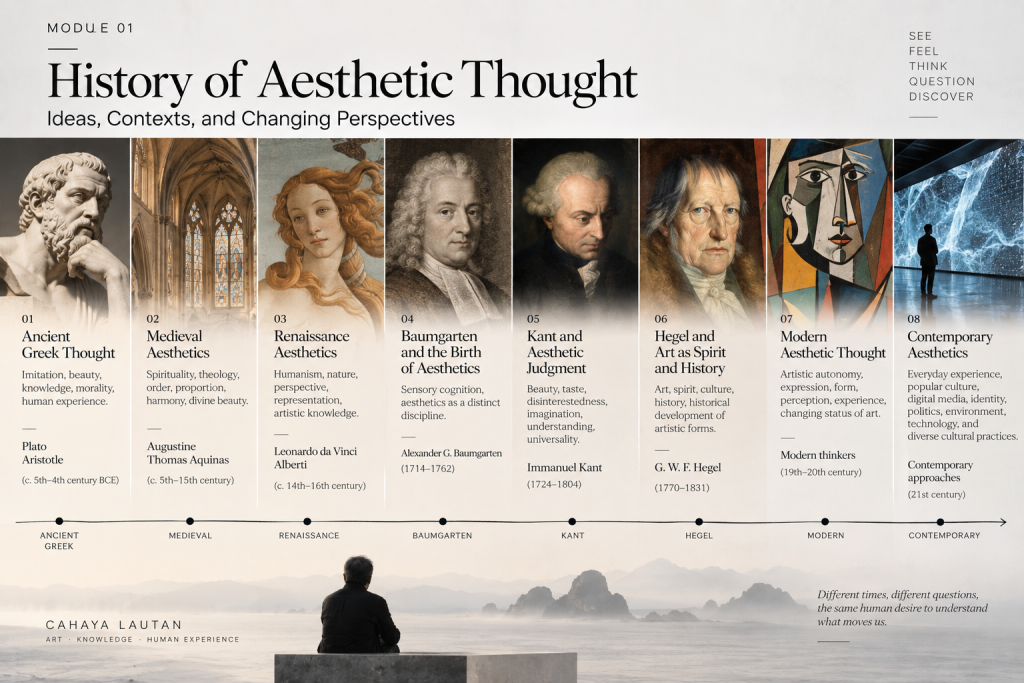
The questions of beauty, art, experience, and value have a long intellectual history. Ideas about aesthetics did not emerge suddenly as a separate philosophical discipline. They developed gradually through changing understandings of art, nature, beauty, knowledge, human experience, and society.
This history provides an important foundation for understanding why different thinkers have proposed different answers to the question: What makes an artwork meaningful or valuable?
The development of aesthetic thought can be approached through several important moments:
01 — Ancient Greek Thought
Plato and Aristotle explored art in relation to imitation, beauty, knowledge, morality, and human experience.
02 — Medieval Aesthetics
Aesthetic thought became closely connected with spirituality, theology, order, proportion, harmony, and the nature of divine beauty.
03 — Renaissance Aesthetics
Humanism, observation of nature, perspective, representation, and artistic knowledge transformed ideas about the artist and the work of art.
04 — Baumgarten and the Birth of Aesthetics
Alexander Gottlieb Baumgarten introduced aesthetics as a distinct philosophical discipline concerned with sensory cognition and established the term aesthetics in its modern philosophical sense.
05 — Kant and Aesthetic Judgment
Immanuel Kant examined beauty, taste, disinterestedness, imagination, understanding, and the claim to universality in aesthetic judgment.
06 — Hegel and Art as Spirit and History
Georg Wilhelm Friedrich Hegel understood art in relation to the development of spirit, culture, and history, emphasizing the historical character of artistic forms.
07 — Modern Aesthetic Thought
Modern thinkers developed new approaches to artistic autonomy, expression, form, perception, experience, and the changing status of art.
08 — Contemporary Aesthetics
Contemporary approaches expand aesthetics beyond traditional concepts of beauty to include everyday experience, popular culture, digital media, identity, politics, environment, technology, and diverse cultural practices.
Understanding this history does not mean memorizing a sequence of philosophers. More importantly, it allows us to see how the central questions of aesthetics have changed, expanded, and been reconsidered across different historical and cultural contexts.
REFLECTION
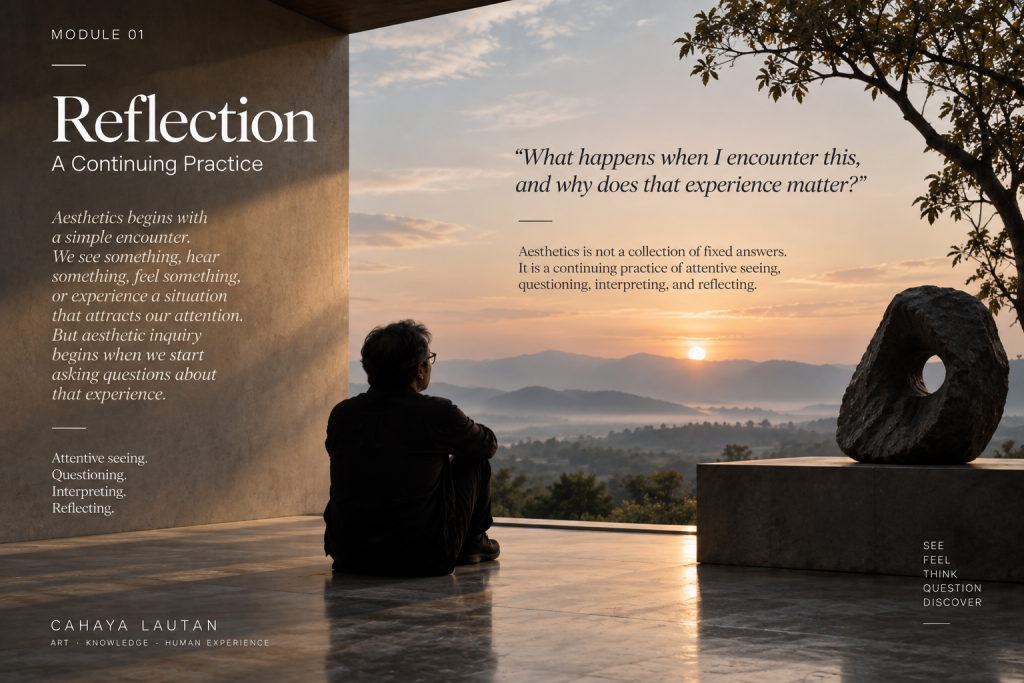
Aesthetics begins with a simple encounter: we see something, hear something, feel something, or experience a situation that attracts our attention.
But aesthetic inquiry begins when we start asking questions about that experience.
Why does this artwork affect me?
What makes me consider something beautiful, disturbing, meaningful, or valuable?
Would another person experience the same artwork differently?
How much of my judgment comes from the artwork itself, and how much comes from my experience, culture, knowledge, and expectations?
These questions remind us that aesthetics is not a collection of fixed answers. It is a continuing practice of attentive seeing, questioning, interpreting, and reflecting.
For artists and students of art, aesthetic thinking is therefore not separate from artistic practice. It becomes part of the way we observe the world, develop ideas, make artistic decisions, and understand the experiences created through art.
The most important question is not simply:
“Is this beautiful?”
but rather:
“What happens when I encounter this, and why does that experience matter?”
REFERENCES & FURTHER READING
The following works provide foundations for further study of aesthetics, art, aesthetic experience, judgment, and value.
Baumgarten, A. G. (1750). Aesthetica.
Beardsley, M. C. (1981). Aesthetics: Problems in the Philosophy of Criticism. Hackett.
Dewey, J. (1934). Art as Experience. Minton, Balch & Company.
Hegel, G. W. F. (1975). Aesthetics: Lectures on Fine Art. Oxford University Press.
Kant, I. (1790/2000). Critique of the Power of Judgment. Cambridge University Press.
Plato. Republic. Various editions.
Aristotle. Poetics. Various editions.
Ricoeur, P. (1976). Interpretation Theory: Discourse and the Surplus of Meaning. Texas Christian University Press.
Shusterman, R. (1992). Pragmatist Aesthetics: Living Beauty, Rethinking Art. Blackwell.
Further reading will be developed throughout the subsequent modules, connecting classical aesthetic thought with modern, contemporary, Indonesian, and Nusantara perspectives.